Last week, a Reddit user named u/SigismundsWrath posted detailed feedback on r/Anki about SlideToAnki. The verdict? 2 out of 5 stars. "Cool concept, smooth experience, worthless output."
That stung. But it was exactly what we needed to hear.
The Problems
Here's what they reported after uploading a 35-slide lecture:
259 cards generated. For 35 slides. That's 7+ cards per slide, way too many. For context, a competitor they tested (Janus) generated 96 cards for the same content.
Cloze deletions on the wrong words. Instead of hiding important medical terms, our AI was hiding articles like "the" and common words like "causes." Example of a bad card:
{{c1::The}} mitral valve is located between the left atrium and ventricle.That tests nothing. You can guess "The" without knowing anything about cardiology.
No Q&A cards. Despite selecting both card types, they got 100% cloze deletions. Mechanisms and reasoning questions were awkwardly forced into cloze format.
Broken math formatting. LaTeX equations came through garbled after about 100 cards.
Redundant content. Multiple cards testing the same fact in slightly different ways.
The user concluded: "These are just not useful cards. 80-90% could be deleted without losing content."
How AI Card Generation Used to Work
Before we explain the fix, here's how our original system worked:
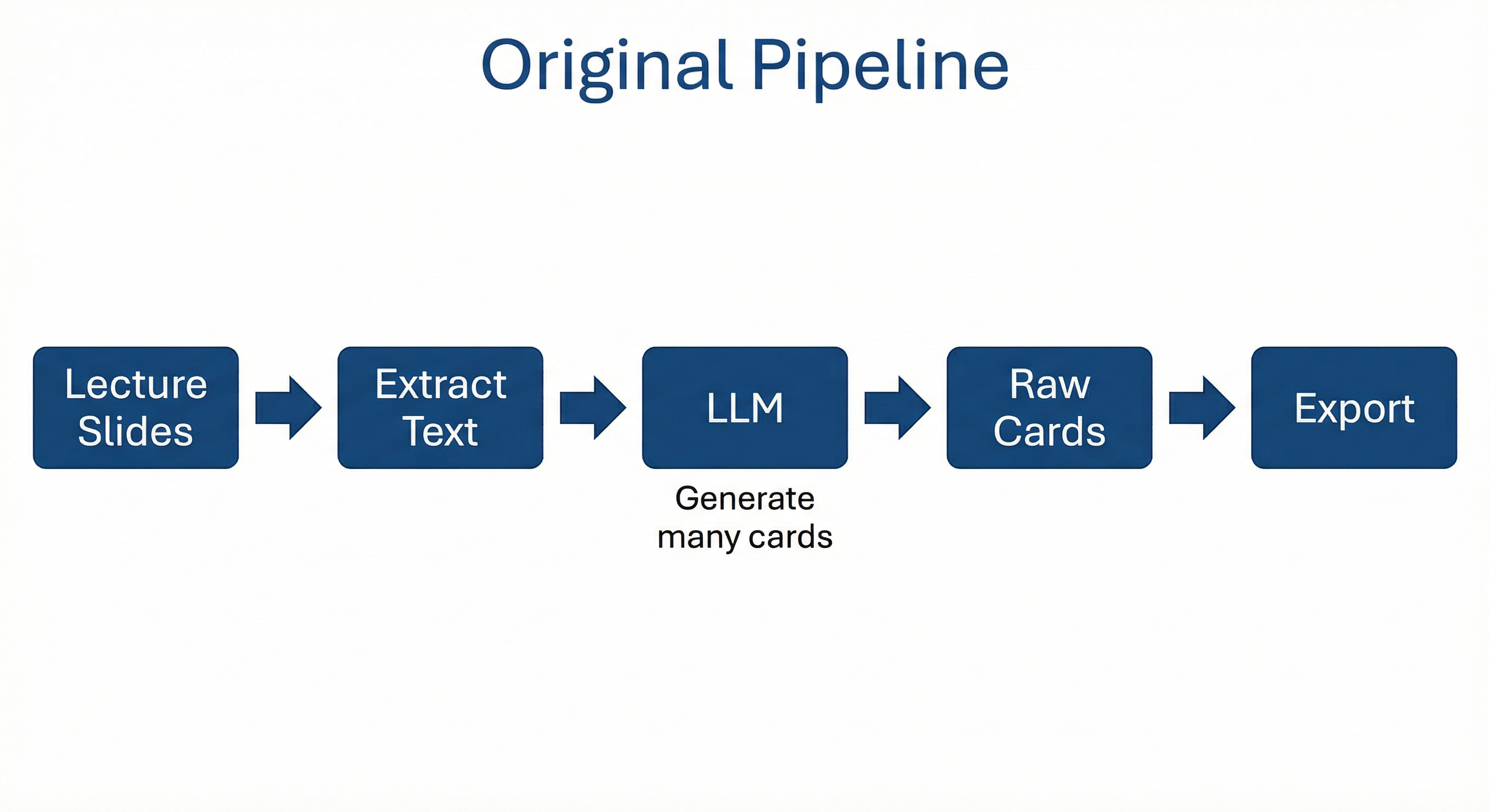
The problem was in the prompt. We told the AI to be thorough and comprehensive. It interpreted that as "make a lot of cards." More cards = more thorough, right?
Wrong. More cards often means more redundancy, more filler, and more time wasted reviewing garbage.
The v2.0 Rebuild
We rewrote the card generation from scratch. Here's the new architecture:
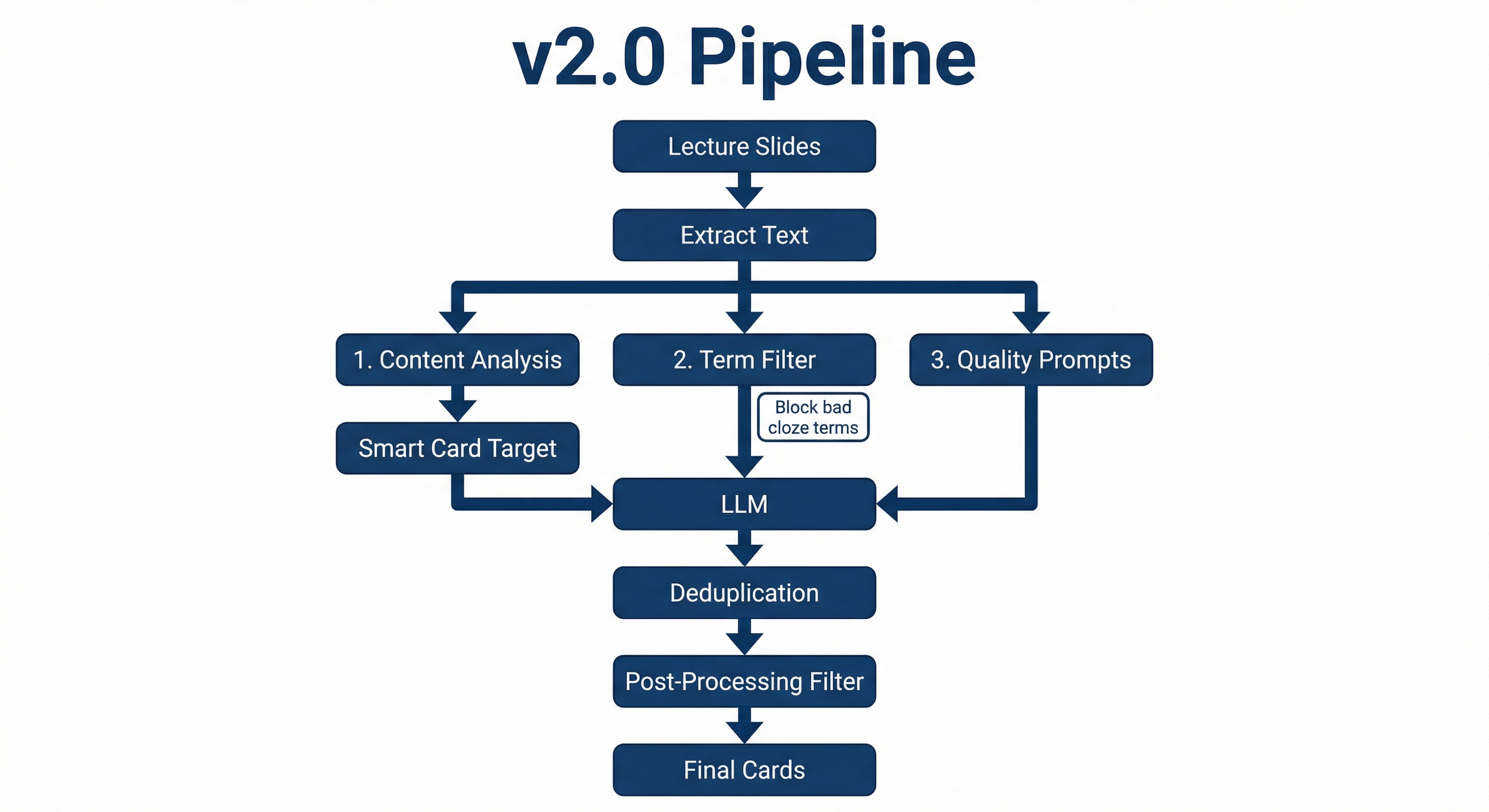
Let's break down each improvement:
1. Smart Card Count Targeting
Instead of "as many as possible," we now analyze the content first:
- How many slides?
- How dense is each slide (character count, concept density)?
- What types of content (facts vs. mechanisms vs. diagrams)?
Based on this analysis, we target 1.5 to 2.5 cards per slide depending on density. A title slide gets 0-1 cards. A dense pharmacology slide might get 3.
Result: 35 slides now generates ~52 cards instead of 259.
2. Forbidden Cloze Term Filter
We built a blocklist of terms that should never be hidden in a cloze deletion:
BLOCKED: the, a, an, is, are, was, were, this, that,
         in, on, at, to, for, of, with, by, from,
         important, common, patient, treatment, causes...
Any card that tries to cloze these terms gets rejected before it reaches you.
Good cloze terms: Medical terms, drug names, anatomical structures, lab values, enzymes, receptors, pathways, mechanisms.
Bad cloze terms: Articles, prepositions, adjectives like "important," generic nouns like "patient."
3. Maximum 2 Cloze Deletions Per Card
Cards with 3+ blanks are hard to review and often test too many things at once. We now enforce a strict limit: maximum 2 cloze deletions per card.
A card like this gets rejected:
The {{c1::SA node}} fires at {{c2::60-100}} bpm and is located in the {{c3::right atrium}}.Instead, the system creates two focused cards:
Card 1: The SA node fires at {{c1::60-100}} bpm.
Card 2: The SA node is located in the {{c1::right atrium}}.
4. Q&A Cards for Mechanisms
We updated the prompts to generate a mix: roughly 60-70% cloze deletions for facts, 30-40% Q&A for reasoning.
The system now recognizes when a concept is better tested as a question:
- Facts, values, names → Cloze deletion
- "Why does X happen?" → Basic Q&A
- Mechanisms, pathways → Basic Q&A
- Comparisons → Basic Q&A
- Clinical reasoning → Basic Q&A
Example Q&A card generated:
Front: Why does hyperkalemia cause peaked T waves on ECG?

Back: Elevated extracellular K⁺ accelerates phase 3 repolarization,
      shortening the action potential duration and producing tall,
      narrow T waves.
5. LaTeX/Math Preservation
We added detection for mathematical content and proper conversion to Anki's MathJax syntax. Chemical formulas (H₂O, CO₂), equations, and Greek letters now come through correctly.
6. Concept Deduplication
As cards are generated across batches, we track what concepts have already been tested. If a new card has 70%+ term overlap with an existing card, it gets skipped.
This prevents the old problem of getting 5 slightly different cards all testing the same fact about the SA node.
Quality Over Quantity
The core philosophy shift: fewer, better cards.
The Reddit user who tested Janus gave it 5 stars partly because it generated fewer cards (96 vs. our 259). Those 96 cards were "well-formatted, good content extraction."
We're not trying to maximize card count. We're trying to maximize learning per card. A deck of 50 excellent cards beats a deck of 200 mediocre ones every time.
What's Next
This update is live now on SlideToAnki. If you tried us before and were disappointed, we'd genuinely appreciate a second look.
We're also working on:
- Better image occlusion that targets the right labels in diagrams
- User feedback integration so cards that get edited or deleted inform future improvements
To the users who took time to write detailed feedback on Reddit: thank you. Criticism is how products get better. We read every comment, and we're committed to earning that 5-star rating.
---
Have feedback on the new card quality? Find a bug? Let us know at slidetoanki.com or drop a comment on our Reddit thread.